all insights

Dear Project Manager, what is your Ikigai?…

Dear Project Manager, what is your Ikigai?…
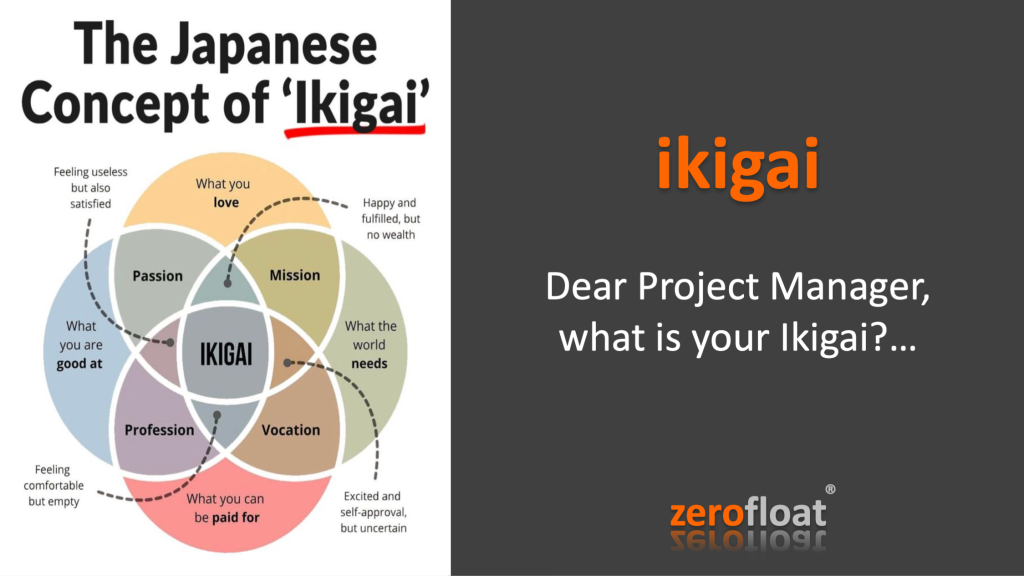
The Concept ✔️ This Japanese concept diagram below shows ikigai as the convergence of four areas of life: what you love, what you’re good at, what the world needs, and what you can be paid for. The very center, where each area overlaps, is your ikigai – your reason for getting up and where you should focus your efforts to find ultimate fulfillment. Ikigai and Your Career✔️ Taking the cue from the four elements diagram, seeking your ikigai is akin to finding your dream job. Imagine combining what you love, what you’re good at, what the world needs, and – the kicker – what you can get paid for. Is it even possible? Finding Your Calling✔️ Consider which types of tasks give you the most pleasure in your current job:
  1. Do you enjoy managing people or working in isolation on technical tasks?
  2. Do you get satisfaction from solving complex issues or prefer giving presentations and chairing interviews?
  3. Do you like directly managing stakeholders or do you love to get stuck into a spreadsheet?
By slowly sifting out the aspects of your work you don’t enjoy, and increasing what you do, you can start to gain a sense of your ikigai. Like, share, repost and comment with your thoughts….???? Credit: mindtools Need help? Explore how zerofloat can help you control your project.
explore more insights
all insights

The Project Controls Value Ring

The Project Controls Value Ring
Project controls isn’t just a function—it’s a value engine.

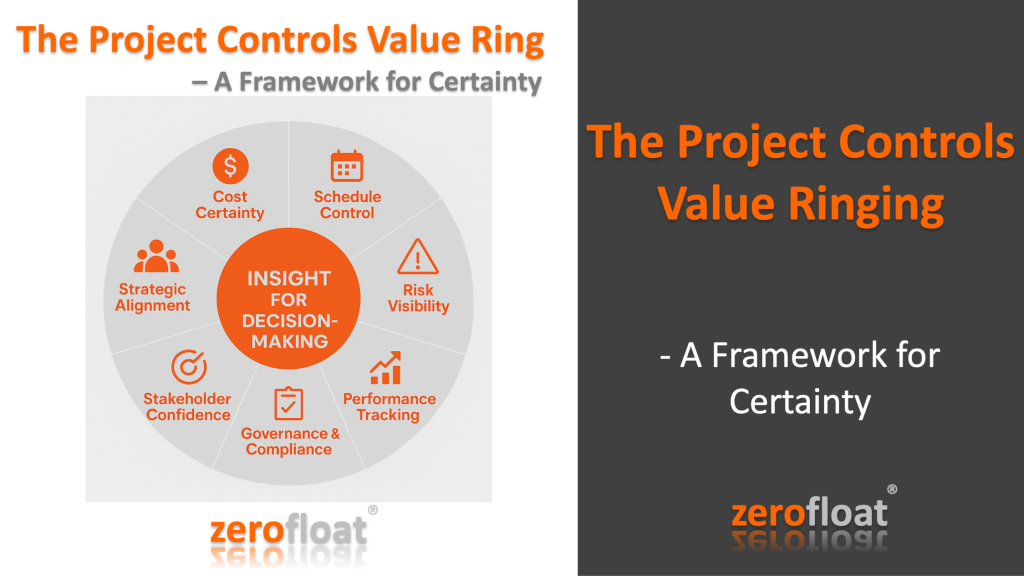
This Value Ring shows how project controls delivers certainty across every layer of a project, from daily decisions to strategic delivery:

At the core is what matters most:
🎯 INSIGHT FOR DECISION-MAKING – where data turns into clarity, and clarity into confident action. The ability to make proactive, informed decisions is the ultimate value-add.

Surrounding Domains include:
💰 Cost Certainty – Clear forecasts, controlled budgets
🕒 Schedule Control – Realistic timelines, critical path visibility
⚠️ Risk Visibility – Early warnings, quantified impact
📊 Performance Tracking – Progress accuracy, data-driven reviews
📝 Governance & Compliance – Assurance, auditability, integrity
🤝 Stakeholder Confidence – Trust built through transparency
🎯 Strategic Alignment – Projects that serve the mission, not just the plan

This is the value ring that drives major projects forward, especially in complex environments like defence, infrastructure, mining and metals, oil and gas, power and coal, LNG, chemical and petrochemical, and capital-intensive delivery.

At zerofloat, we use this lens to strengthen project controls and PMOs, sharpen controls, and help leadership teams move with confidence.

Which part of the value ring does your organisation struggle with most, and how are you addressing it?

Need help? Explore how zerofloat can help you control your project.
explore more insights
all insights

EPC vs. EPCM

EPC vs. EPCM
EPC (Engineering, Procurement and Construction) and EPCM (Engineering, Procurement and Construction Management) contracts.
Which contract is better?
Are you taking advantage of forming the right contract type during contract negotiations to suit the situation and overall goals of the project?
EPC and EPCM contracting are both very prevalent types of contracts within the construction industry. Depending on the level of risk the Owner of a project is willing to accept, budget constraints, and the Owner’s organisation’s core competencies, will determine which method is best for their project.
Let’s check some general characteristics of EPC vs. EPCM this time.
TypeEPCEPCM
MeaningThe company is contracted to provide engineering, procurement and construction services by the owner. Think Design & Construct style contracts, where the project is largely Contractor managed and the cost risk and control are weighted towards the Contractor and away from the Owner. The EPC contractor has direct contracts with the construction contractors.The company is contracted to provide engineering, procurement and construction management services. Other companies are contracted by the Owner directly to provide construction services and they are usually managed by the EPCM contractor on the Owner’s behalf. Think Professional Services contracts, where the project is largely Owner-managed and the cost risk and control is weighted towards the Owner.
EstablishmentBest for well-defined projects with detailed engineering complete before EPC contractor selected (Minimal Unknowns). It takes a long time to set up an EPC.Better for less-defined projects with anticipated changes to the scope of supply. EPCM initiated quickly.
Client Ownership“Hands off” approach to the project.Sense of ownership and more control over the process.
LegalMinimal Legal Risk.Sense of ownership and more control over the process.
ScheduleEPC is based on a fixed implementation schedule, changes to the schedule can be very expensive.There is the ability to accelerate or slow down the implementation of EPCM projects.
CostTends to be more expensive, to the Owner, due to the shift of project risk away from the Owner and to the EPC Contractor. On average, a project’s cost 10% – 20% more.Lower cost due in large part to the project’s risk being more evenly distributed between the Owner and contracts/suppliers.
FinanceLocked in on finance.Can support flexible financing.
As stated before, these contract methods can be tailored to the individual projects/owner’s needs. Some owners can go as far as breaking up each portion of the EPC / EPCM (Engineering, Procurement, Construction / Construction Management) to separate companies. One company can do the engineering; another can do the procurement, while still another can do the construction/project management.
We can discuss the contractual aspect next time. Let us know your thoughts.
Need help? Explore how zerofloat can help you control your project.
explore more insights
all insights

Ten Best Practices for Schedule

Ten Best Practices for Schedule
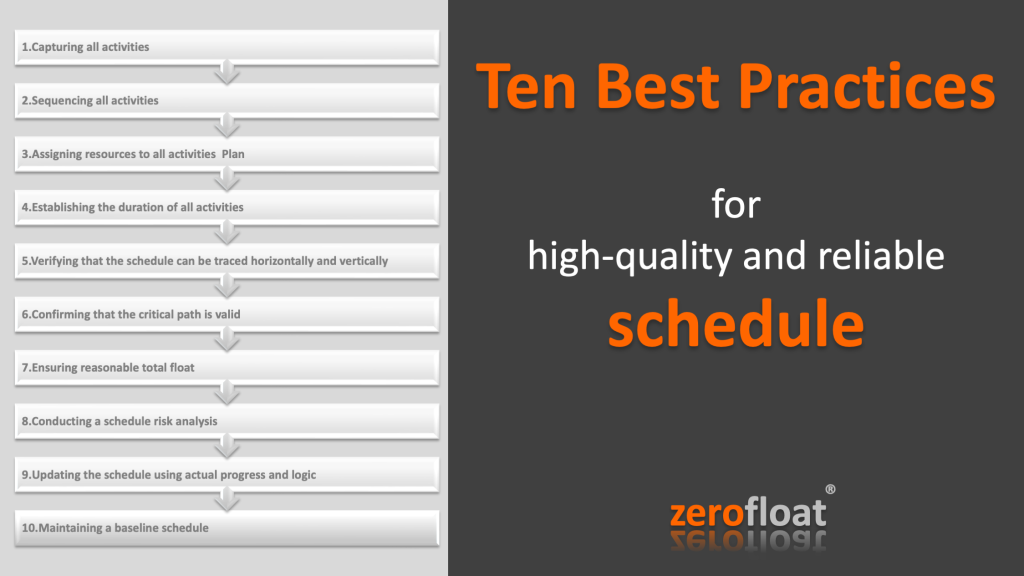
The ten best practices associated with a high-quality and reliable schedule and their concepts are as follows.
1. Capturing all activities. The schedule should reflect all activities as defined in the program’s work breakdown structure (WBS), which defines in detail the work necessary to accomplish a project’s objectives, including activities both the owner and the contractors are to perform.
2. Sequencing all activities. The schedule should be planned so that critical program dates can be met. To do this, activities must be logically sequenced and linked—that is, listed in the order in which they are to be carried out and joined with logic. In particular, a predecessor activity must start or finish before its successor. Date constraints and lags should be minimized and justified. This helps ensure that the interdependence of activities that collectively lead to the completion of activities or milestones can be established and used to guide work and measure progress.
3. Assigning resources to all activities. The schedule should reflect the resources (labour, materials, travel, facilities, equipment, and the like) needed to do the work, whether they will be available when needed, and any constraints on funding or time.
4. Establishing the duration of all activities. The schedule should realistically reflect how long each activity will take. When the duration of each activity is determined, the same rationale, historical data, and assumptions used for cost estimating should be used. Durations should be reasonably short and meaningful and should allow for discrete progress measurement. Schedules that contain planning and summary planning packages as activities will normally reflect longer durations until broken into work packages or specific activities.
5. Verifying that the schedule can be traced horizontally and vertically. The schedule should be horizontally traceable, meaning that it should link products and outcomes associated with other sequenced activities. Such links are commonly referred to as “hand-offs” and serve to verify that activities are arranged in the right order for achieving aggregated products or outcomes. The schedule should also be vertically traceable— that is, data are consistent between different levels of a schedule. When schedules are vertically traceable, lower-level schedules are clearly consistent with upper-level schedule milestones, allowing for total schedule integrity and enabling different teams to work to the same schedule expectations.
6. Confirming that the critical path is valid. The schedule should identify the pro- gram’s critical path—the path of the longest duration through the sequence of activities. Establishing a valid critical path is necessary for examining the effects of any activity’s slipping along this path. The program’s critical path determines the program’s earliest completion date and focuses the team’s energy and management’s attention on the activities that will lead to the project’s success.
7. Ensuring reasonable total float. The schedule should identify reasonable total float (or slack)—the amount of time a predecessor activity can slip before the delay affects the program’s estimated finish date—so that the schedule’s flexibility can be determined. The length of delay that can be accommodated without the finish date’s slipping depends on the number of date constraints within the schedule and the degree of uncertainty in the duration estimates, among other factors, but the activity- ty’s total float provides a reasonable estimate of this value. As a general rule, activities along the critical path have the least total float. An unreasonably high total float on an activity or path indicates that schedule logic might be missing or invalid.
8. Conducting a schedule risk analysis. A schedule risk analysis starts with a good critical path method schedule. Data about program schedule risks are incorporated into a statistical simulation to predict the level of confidence in meeting a program’s completion date; to determine the contingency, or reserve of time, needed for a level of confidence; and to identify high-priority risks. Programs should include the results of the schedule risk analysis in constructing an executable baseline schedule.
9. Updating the schedule using actual progress and logic. Progress updates and logic provide a realistic forecast of start and completion dates for program activities. Maintaining the integrity of the schedule logic is necessary to reflect the true status of the program. To ensure that the schedule is properly updated, people responsible for the updating should be trained in critical path method scheduling.
10. Maintaining a baseline schedule. A baseline schedule is the basis for managing the program scope, the time period for accomplishing it, and the required resources. The baseline schedule is designated the target schedule and is subjected to a configuration management control process. Program performance is measured, monitored, and reported against the baseline schedule. The schedule should be continually monitored so as to reveal when forecasted completion dates differ from baseline dates and whether schedule variances affect downstream work. A corresponding basis document explains the overall approach to the program, defines custom fields in the schedule file, details ground rules and assumptions used in developing the schedule, and justifies constraints, lags, long activity durations, and any other unique features of the schedule.
The ten best practices represent the key concepts of a reliable schedule. These best practices are in no particular order; they are not intended as a series of steps for developing the schedule.
Source: GAO-16-89G, Schedule Assessment Guide: Best Practices for Project Schedules
Need help? Explore how zerofloat can help you control your project.

explore more insights
all insights

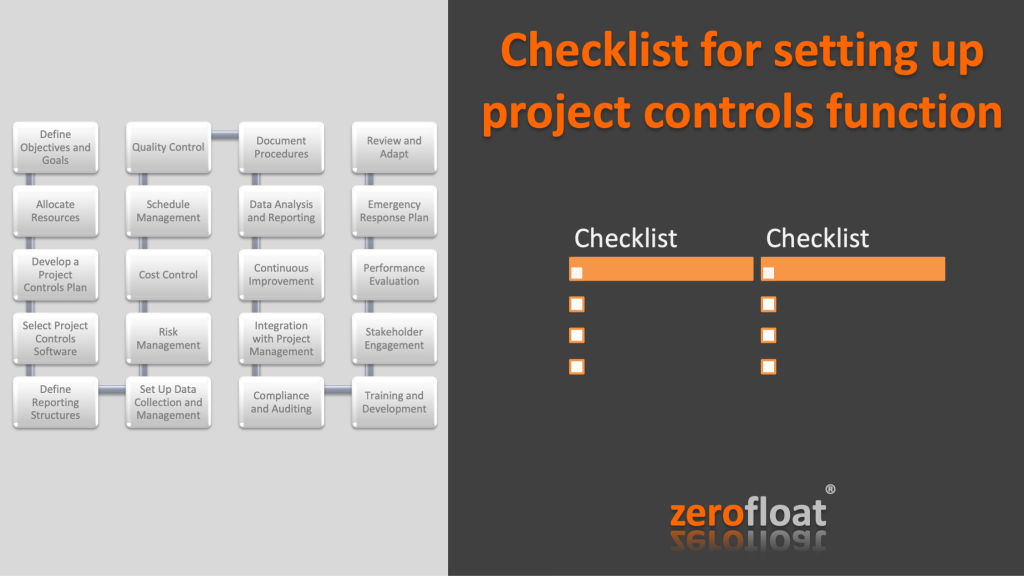
Checklist for setting up project controls function

Checklist for setting up project controls function
Setting up a project controls function is essential for effective project management. This checklist outlines the key steps and considerations for establishing a project controls function within your organisation. Customise it to suit your specific project and organisational needs:
01. Define Objectives and Goals:
  • Clarify the purpose and objectives of the project controls function.
  • Establish measurable goals and key performance indicators (KPIs) for the function.
02 Allocate Resources:
  • Identify and allocate the necessary budget, personnel, and technology resources.
  • Assign roles and responsibilities within the project controls team.
03 Develop a Project Controls Plan:
  • Create a comprehensive project controls plan that outlines strategies, processes, and procedures.
  • Include risk management, cost control, schedule management, and quality control components.
04 Select Project Controls Software:
  • Choose suitable project management and controls software to support data collection, analysis, and reporting.
  • Ensure the software aligns with your project’s requirements and scale.
05 Define Reporting Structures:
  • Establish reporting hierarchies and communication channels.
  • Determine reporting frequency and formats for different stakeholders.
06 Set Up Data Collection and Management:
  • Define data collection methods and tools for gathering project performance data.
  • Implement data storage and management systems for easy access and analysis.
07 Risk Management:
  • Develop a risk management framework, including risk identification, assessment, mitigation, and monitoring processes.
  • Assign responsibility for risk management tasks.
08 Cost Control:
  • Create a cost control system to monitor project expenses.
  • Set up a cost baseline and track actual costs against the budget.
09 Schedule Management:
  • Establish a schedule control process to monitor progress against project timelines.
  • Develop a baseline schedule and track deviations.
10 Quality Control:
  • Define quality control standards and procedures.
  • Implement a system for monitoring and ensuring project quality.
11 Document Procedures:
  • Document all project controls processes and procedures in a standardised format.
  • Ensure that team members are trained in these procedures.
12 Data Analysis and Reporting:
  • Analyse project performance data regularly to identify trends and areas needing improvement.
  • Generate comprehensive and informative reports for project stakeholders.
13 Continuous Improvement:
  • Encourage a culture of continuous improvement within the project controls function.
  • Regularly review and update processes to enhance efficiency and effectiveness.
14 Integration with Project Management:
  • Ensure seamless integration between the project controls function and the overall project management processes.
  • Collaborate with project managers and other relevant teams.
15 Compliance and Auditing:
  • Ensure that project controls processes comply with relevant industry standards and regulations.
  • Prepare for internal and external audits as needed.
16 Training and Development:
  • Provide training and professional development opportunities for project controls team members.
  • Stay updated on industry best practices and emerging technologies.
17 Stakeholder Engagement:
  • Engage with project stakeholders to understand their reporting needs and expectations.
  • Communicate regularly to keep stakeholders informed about project performance.
18 Performance Evaluation:
  • Establish a performance evaluation process for the project controls function.
  • Use feedback and data to continuously improve the function’s effectiveness.
19 Emergency Response Plan:
  • Develop a plan to address unforeseen issues or crises that may impact project controls.
  • Ensure the ability to adapt to changing circumstances.
20 Review and Adapt:
  • Periodically review the effectiveness of your project controls function.
  • Adapt and refine processes as necessary to meet changing project requirements.
Setting up a robust project controls function is a crucial step toward successful project management. This checklist can serve as a guide to ensure that you cover all necessary aspects during the setup process.
Checklist for setting up project controls function
Need help? Explore how zerofloat can help you control your project.
explore more insights
all insights

What a Project Planner says vs What a Planner means

What a Project Planner says vs What a Planner means
“What a Project Planner says vs What a Planner means”…

If you’re a project planner, you KNOW these translations are (almost) true…

Behind every perfectly crafted schedule, there’s a whole lot of real-world translation happening!

Here’s what planners say vs what they actually mean behind the scenes!
…
Planner says:
“We’re slightly off track.”
Planner means:
“It’s not a disaster yet… but give it a week.”
…
Planner says:
“We’ll need to rebaseline.”
Planner means:
“We’re now officially making up a new plan because the old one exploded.”
…
Planner says:
“There are some dependencies to manage.”
Planner means:
“You just triggered a domino effect that will haunt us for weeks.”
…
Planner says:
“We’re recommending schedule compression.”
Planner means:
“Congratulations — you’ve just signed up for nights and weekends.”
…
Planner says:
“We’re monitoring progress closely.”
Planner means:
“We’re holding this whole project together with duct tape and hope.”
…
Planner says:
“We’ll conduct a scenario analysis.”
Planner means:
“I’m already calculating three worst-case disasters… and two backups for each.”
…

Tag a planner who’s a master of ‘project code’! What’s your favourite secret translation? Drop your thoughts below and feel free to repost.
Need help? Explore how zerofloat can help you control your project.
explore more insights
all insights

How can you make time and be productive?

How can you make time and be productive?
As we all know time plays a significant role in our life. Time helps us make a good habit of structuring and organizing our daily activities. If you understand the value of time better, you can gain experience and develop skills over time. Time is the most valuable resource because you cannot take it back. As said “you can’t manage time but you can manage priority” Saying that there are some ways that you can make time and be productive. Here are some tips:
  1. Focus on most important tasks first
  2. Set deadline and stick to plan
  3. Remove distractions
  4. Keep mind fresh and work when most productive
  5. Use the 80/20 rule, you can’t have everything 100%.
  6. Break tasks into smaller pieces
  7. Take breaks
  8. Set reminders
  9. Brain dump your thoughts
  10. Make fewer decisions
  11. Eliminate inefficient communication
  12. Find repeatable shortcuts and get into a routine
  13. Learn from successes as well as mistakes
  14. Plan for when things go wrong
  15. Work before you get motivated or inspired
  16. Delegate tasks
  17. Don’t multitask
  18. Fill the tank — recharge
  19. Sharpen the axe
  20. Manage your energy (not just time)
  21. Only take on what you can finish
  22. Get better at saying “no”
Happy to see your tricks and tips to make more time.
explore more insights
all insights

Change the way manage change

Change the way manage change
Do you know that the Number 1 risk to project success is “change”?
The recognition of the value of change management changed over the last few decades and still for any project the number one risk to project success is “change”.
One in six projects has an average cost overrun of 200% and 70% schedule overrun. Scope Creep is one of the most recurring themes in project failures.
Change is inevitable and natural; you can count on it. Change is the only constant in project life.
It is important to understand that our job is not to stop scope change but to successfully manage that change.
Managing change begins with knowing the original scope. The change control process in project management ensures that each change proposed during a project is adequately defined, reviewed and approved before implementation.
Change control contains five stages:
  • 1. Proposing a Change
  • 2. Summary of Impact
  • 3. Decision
  • 4. Implementing a Change
  • 5. Closing a Change
The key takeaway for good change control:
  • 1. Know your scope – you can only identify change if you know what you started with.
  • 2. Early identification – the key is to identify change early.
  • 3. Avoid gold plating- frequent team contact to avoid suddenly the “nice to haves” becoming “must-haves”.
  • 4. Don’t be afraid to say ”NO”, If it’s not in the best interest of the project.
Let’s change the way we manage change.
Need help? Explore how zerofloat can help you control your project.
explore more insights
all insights

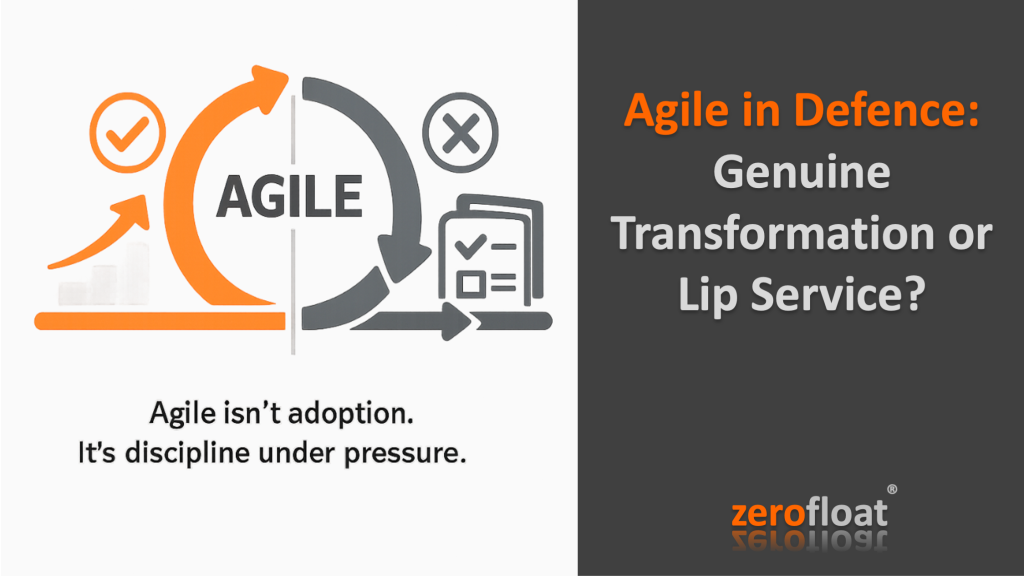
Agile in Defence: Genuine Transformation or Lip Service?

Agile in Defence: Genuine Transformation or Lip Service?
Let’s explore a question many of us are quietly asking.
We are seeing both.
In some Defence programs, Agile is genuinely shifting how work gets done, faster decisions, earlier risk visibility, and a tighter connection to mission outcomes.
In others, it’s simply a change in language. > Same governance layers.
> Same slow approvals.
> Same hesitation to surface bad news.
From my experience, Agile in Defence becomes real only when four things change:
  • Leadership behaviour – moving from control to intent and trust
  • Decision-making speed – reducing latency, not just adding ceremonies
  • Transparency – rewarding early signals, not punishing them
  • Governance rhythms – becoming adaptive, evidence-based, and closer to delivery
Agile is not a set of stand-ups and sprints.
It is a decision-making model.
And in high-assurance environments like Defence, the goal is not less governance, it is better, more responsive governance.
If teams are “Agile” but funding, approvals, and reporting remain rigid, transformation will stall.
If bad news travels slowly, Agile is already failing.
explore more insights
all insights

The 90/10 rule for Projects

The 90/10 rule for Projects
Have you experienced the same way on your project?
Why last 10% take 90% of the time?
That is the 90/10 rule for Projects.
The last little bit to complete takes forever and consumes a lot of resources and costs.
I have seen a project manager get sick of the last 5% of engineering to be completed on the project and demobilise the engineering team without completing the last 5%. That’s the only way to get 100%.
This is applicable not only for engineering but for any function and the total project too.
The reasons for this challenge to complete the last bit are mainly
  • keeping unknown and difficult tasks in the parking lot;
  • last minutes changes led to running out of time to complete;
  • project is almost finishing and resources are pulled off or shared with other projects;
  • project is not a priority anymore;
  • the team dropped the ball and ran away.
So how can I finish my last 10 % effectively to make 100% complete?
It’s not easy, but a few steps below may help.
  • Keep project end state in mind;
  • Plan the last 10% as an independent project itself;
  • Plan every single bit in detail to be finished;
  • Make sure to have assigned resources ;
  • Get priority right;
  • Get help from closeout experts;
  • Ensure Management support to finish the project.
Need help? Explore how zerofloat can help you control your project.
explore more insights