Are you in the process of setting up a project controls function for your project or organisation?
It is a challenging task.
Let’s talk about the tips for objectives, success factors, risks, and issues that can help you with the task.
Setting up a project controls function is a critical step in ensuring the successful execution of projects within an organization. Here are some tips for defining objectives, success factors, identifying risks, and addressing issues:
Objectives
Project objective realised
Projects delivered on time and budget
All variances managed, explained, and approved
Smooth predictable delivery throughout
Final project outcomes predicted well in advance
Success factors
Project Controls process implemented & adhered to
Suitable project data structures implemented
Process tailored to meet specific project requirements
Staff adequately trained & supported
Appropriate systems properly configured & supported
Project mindset to control: Scope, Cost, Time
Change management focus
Risk and issues
Controls function inadequately resourced
Lack of team buy-in to control the process
Scope Creep/Change management ignored
Warning and lead indicators ignored
Overly optimistic/unrealistic schedule and progress measurement
Discrepancies in data from various sources can lead to confusion and misinterpretation
Delays in collecting, analysing, and reporting data can impact decision-making and responsiveness
Remember that successful implementation of a project controls function requires a combination of process design, technology, stakeholder engagement, and ongoing monitoring.
Regularly review your objectives, success factors, risks, and issues to ensure that your project controls function remains effective and aligned with your project or organisation’s goals.
What tips would you add to the list above?Need help? Explore how zerofloat can help you control your project.
Dashboard Software. Which data analytics is better?
A dashboard is a type of graphical user interface that often provides at-a-glance views of key performance indicators relevant to a particular objective or business process.
A data dashboard is an information management tool that visually tracks, analyses and displays key performance indicators (KPI), metrics and key data points to monitor the health of a business, department or specific process.
The easiest way to create a dashboard is in Microsoft Excel. The Excel Dashboard is used to display overviews of large data tracks. Excel Dashboards use dashboard elements like tables, charts, and gauges to show the overviews.
There are many analytic tools available on market but two are leading in the way they add value. PowerBI and tableau.
Power BI comes at a lower price point than tableau, but scaled features and additional users will increase that price. It is made for high-end users.
The tableau is built for data analysts, while Power BI is better suited to a general audience that needs business intelligence to enhance their analytics.
You can create dashboards with Power BI or Tableau, but the greatest difference is in the way you experience insights through analysis.
Which data analytics software are you using? Please share the Dashboard journey and end-user experience here.
Need help? Explore how zerofloat can help you control your project.
Power Interest Grid for Stakeholder Prioritisation
Have you felt that you are spending more time managing stakeholders than managing your project?
As said, most time you can not manage time but you can manage priority.
The key to success in stakeholder management is to know your stakeholders and priorities them based on their influence on your project success based on their power and interest.
Stakeholder Management is the process by which you identify your key stakeholders and win their support. Stakeholder Analysis is the first stage of this, where you identify and start to understand your most important stakeholders.
Get the list of people (Stakeholders) and identify that some of these may have the power either to block or deteriorate your project work or to advance it. Some may be interested in what you are doing, while others may not care, so you need to work out who you need to prioritise.
You can map out your stakeholders, and classify them according to their power over your work and their interest in it, on a Power/Interest Grid.
The position that you allocate to a stakeholder on the grid shows you the actions you need to take with them to make your project successful.
High power, highly interested people = Manage Closely: you must fully engage these people, and make the greatest efforts to satisfy them. These are the stakeholders who are decision-makers and have the biggest impact on the project success and hence you must closely manage their expectations.
High power, less interested people= Keep Satisfied: put enough work in with these people to keep them satisfied, but not so much that they become bored with your message. These are the stakeholder needed to be kept in the loop, these stakeholders need to be kept satisfied even though they aren’t interested because they yield power. These types of stakeholders should be dealt with cautiously as well since they may use their power in a not desired way in the project if they become unsatisfied
Low power, highly interested people = Keep Informed: adequately inform these people, and talk to them to ensure that no major issues are arising. People in this category can often be very helpful with the detail of your project.
Low power, less interested people = Monitor: again, monitor these people, but don’t bore them with excessive communication.
This analysis will also help you prepare RACI – Responsible, Accountable, Consulted, and Informed matrix as well.
Reference
https://www.mindtools.com/pages/article/newPPM_07.htm
Need help? Explore how zerofloat can help you control your project.
The following is a simplified comparison of key (major) differences between EPC (Engineering, Procurement and Construction) and EPCM (Engineering, Procurement and Construction Management) contracts. The contractual type issues can be modified during contract negotiations to suit the situation and overall goals of the project.
Let’s check some contractual aspects of EPC vs. EPCM this time.
Type
EPC
EPCM
Equipment Supply Contracts
Negotiated & Signed solely between EPC contractor & Supplier
Negotiated & signed between Owner and Supplier /with EPCM contractor’s advise and assistance
On-Site Construction Contracts
Negotiated & Signed solely between EPC contractor & Supplier
Negotiated & signed between Owner and Contractor /with EPCM contractor’s advise and assistance
Supplier Selection
Suppliers are chosen solely by EPC contractors with no input from the Owner
Negotiated & signed between Owner and Contractor /with EPCM contractor’s advise and assistance
Scope of Supply
EPC Contract is only as good as the original project specifications presented during the bidding process. Changes to specifications/scope of supply after awarding of contract can be expensive, due to EPC contractor’s sole contract with Owner and Owner’s inability to “Shop Around” for multiple quotations from independent contractors/suppliers
Owners can modify project specifications with little or no trouble. The owner, with the assistance of the EPCM contractor, can negotiate independent contracts with suppliers/vendors at any time due to the fact that the project is under multiple (independent) contracts and not one (1) all-encompassing contract
Equipment Supply Warranties
Warranties negotiated by Suppliers & EPC contractor and issued to EPC Contractor directly. Warranty to Owner from EPC contractor is negotiated separately between Owner and EPC Contractor and issued to Owner by EPC Contractor
Warranties are negotiated individually with each supplier by the Owner with the EPCM contractor’s advice. Issued directly to Owner from the suppliers and contractors
Process Warranties
Warranties negotiated by Suppliers & EPC contractor and issued to EPC Contractor directly. Warranty to Owner from EPC contractor is negotiated separately between Owner and EPC Contractor and issued to Owner by EPC Contractor (Usually in the form of a performance Bond)
Warranties are negotiated individually with each supplier by the Owner with the EPCM contractor’s advice. Issued directly to Owner from the suppliers and contractors (Usually in the form of a Performance Bond)
Construction Site Safety (General Liability Insurance, Workman’s Compensation, Accident, etc.)
Site Safety is solely the responsibility of the EPC contractor and subcontractors; in accordance with Contractual Agreements
Site safety is monitored by EPCM contractors but site safety is the legal responsibility of Owner and Sub Contractors; in accordance with Contractual Agreements
Type
EPC
EPCM
Permitting (Environmental, Construction, etc.)
Permitting is the responsibility of the EPC contractor with the exception of permits that are required by law to be issued in the name of the Owner of the project
Permits are issued to the Owner directly with the EPCM contractor assisting in filing the necessary paperwork
Project Budget Cost Overruns
The cost risks for a project are borne by the EPC contractor. Any cost overruns, for equipment and/or services within the EPC contractor’s scope of supply, are for their own account and can not be passed onto the Owner unless “change conditions” occur or contractual agreements to the contrary
The cost risks for a project are borne by the Owner. Any cost overruns, for equipment and/or services, are for the Owner account (with the exception of fixed-price supply contracts) i.e. Final equipment pricing bids / on-site cost higher than originally budgeted.
Project Budget Cost Savings
The cost risks for a project are borne by the EPC contractor. Any cost savings, for equipment and/or services within the EPC contractor’s scope of supply, are for their own account and are not passed onto the Owner unless contractual agreements to the contrary
The cost risks for a project are borne by the Owner. Any cost savings, for equipment and/or services, are for the Owner account ie. Equipment/Services bids are returned lower than budgeted
Project Day-to-Day Expenses
The day-to-day expenses for the project, within the EPC contractor’s scope of supply, are borne by the EPC contractor
The day-to-day expenses for the project are borne by the Owner but are managed and administered by the EPCM contractor (up to pre-determined quantities, without the Owner’s need for intervention). Usually, a small fund is established by the Owner for day-to-day expenses
Project Financing
Project Financing is usually accomplished by substantial down payment by Owner to EPC contractor and the remainder of the fees issued with Irrevocable Letter of Credit (with partial payments) from Owner to EPC Contractor. This requires the Owner to have all financing in place at the onset of the Project so as to secure a letter of credit (LC)
Project Financing can be any combination of down payments, open accounts, and Irrevocable Letters of Credit from Owner to suppliers/contractors; whatever method is negotiated during contract negotiations. EPCM contractor will assist in all negotiations on the Owner’s behalf. This allows the Owner to have partial financing in place at the onset of the Project with the remainder available as needed, depending on contractual requirements
Legal Cost
Legal Costs are low for the Owner. The owner negotiates only one detailed supply contract with the EPC contractor. EPC contractors must negotiate individual contracts with suppliers/vendors. EPC contractor’s legal costs are high due to multiple contracts. In the event of legal action is taken, the Owner must sue the EPC contractor, who in turn must bring legal action against appropriate suppliers/contractors. (Usually a longer process than EPCM legal actions)
Legal Costs are higher for the Owner. Owner negotiates multiple supply contracts directly with suppliers/contractors; with the assistance of EPCM contractor. In the event of legal action is taken, the Owner must bring legal action against individual suppliers/contractors. (Usually a shorter process than EPC legal actions)
Administration
The owner’s administration costs are low with the EPC contract. Only minimal staff (management, QC, legal, etc.) is needed to administer/monitor the project. May have a negative effect on project “ownership” feeling within the Owner’s organisation (Hands off).
The owner’s administration costs are higher with EPCM contracts. Substantial staffing levels are needed to assist/compliment EPCM contractors in administering/monitoring projects. Promotes “ownership” feeling within the Owner’s organisation. Project staff often transferred to operational staff after project completion.
EPC and EPCM contracting are both very prevalent types of contracts within the construction industry. Dependent on the level of risk the Owner of a project is willing to accept, budget constraints, and the Owner’s organisation core competencies, will determine which method is best for their project.
As stated before, these contract methods can be tailored to the individual projects/owner’s needs. Some can go as far as breaking up each portion of the EPC / EPCM (Engineering, Procurement, Construction / Construction Management) to separate companies. One company can do the engineering; another can do the procurement, while still another can do the construction/project management).
Let us know your thoughts.
Need help? Explore how zerofloat can help you control your project.
Mastering Project Slowdowns: 9 Strategies to Keep Your Project on Track
Project delays can be a daunting challenge for any team, but before accepting them as inevitable, it’s crucial to explore proactive approaches to control and mitigate slowdowns. In this blog post, we will delve into nine effective strategies that project managers can employ to navigate through setbacks and ensure successful project completion.
Try these approaches before accepting the inevitability of a delay in project completion.
1. Renegotiate with Stakeholders:
The first step when facing potential delays is to open up a transparent dialogue with stakeholders. Discuss the possibility of increasing the budget or extending the deadline. By renegotiating expectations, you can gain the necessary support to overcome unforeseen obstacles without compromising the project’s success.
2. Use Later Steps to Recover:
Reevaluate your project’s budgets and schedules to identify areas where time can be made up. Shifting resources or rearranging tasks might provide opportunities to regain lost ground. A strategic analysis of the project timeline can uncover hidden possibilities for recovery.
3. Narrow the Project’s Scope:
Consider whether nonessential elements of the project can be dropped to reduce costs and save time. Streamlining the project’s scope allows for a more focused approach, ensuring that essential tasks are completed efficiently without unnecessary complications.
4. Deploy More Resources:
Evaluate the possibility of putting more people or machines to work on critical tasks. While this might incur additional costs, weigh them against the importance of meeting the deadline. Sometimes, an infusion of resources can significantly expedite project timelines.
5. Accept Substitution:
In certain situations, opting for a less expensive or more readily available alternative can be a pragmatic solution. Assess the feasibility of substituting certain components without compromising the overall quality or success of the project.
6. Seek Alternative Sources:
If a specific item or resource is causing delays, explore alternative suppliers or sources. Diversifying your options can mitigate the impact of a single point of failure, ensuring that the project can progress smoothly even in the face of unforeseen challenges.
7. Accept Partial Delivery:
Consider accepting partial delivery of items that are ready now and postpone the remaining components. This allows work to continue on other aspects of the project while waiting for the outstanding elements. It’s a strategic compromise that can prevent a complete standstill.
8. Offer Incentives:
To motivate teams or suppliers to meet deadlines, consider providing bonuses or other incentives. Positive reinforcement can create a sense of urgency and commitment, fostering a collaborative atmosphere geared towards on-time delivery.
9. Demand Compliance:
In some cases, insisting that individuals adhere to their commitments can be a powerful strategy. However, exercise caution and use this tactic selectively, seeking support from upper management if necessary. Striking the right balance is crucial to avoid damaging important relationships while still driving toward project success.
Conclusion:
While project slowdowns may seem like insurmountable challenges, employing these proactive strategies can significantly improve your chances of staying on track. By fostering open communication, flexibility, and creativity, project managers can navigate through unexpected setbacks and lead their teams to successful project completion. Remember, with the right approach, even the most formidable obstacles can be transformed into opportunities for growth and success.
Need help? Explore how zerofloat can help you control your project.
The year 2020 has changed the way we look at our health with the Covid-19 pandemic.
When did you perform a health check on your project? Can you predict your project success?
If you have observed the following Unhealthy Signs below then your project success is at risk.
If you have observed the Healthy Signs below then your project success is more likely achievable.
Executive incentives tied to project KPI
Investments in change management
Subject matter experts dedicated
A compelling reason to implement
The solution doesn’t have to be fancy
The difference can be measured
Data-centric decision making
Options provided to make decision
Roles and responsibilities defined
One accountable person
Good governance in place
Everyone gives the same finish definition
Good evidence of control and tracking for predictable results
Slippage, when it happens, is predicted
Lengthy issues log
Written agreements
Morale is good
The team is diverse
Documented plan
Test-it-first tactics
People feel they are learning
Part of the solution
Good press is being created and willingness to invest in the project
Which signs relate to your project? What lesson will you share with others to help?
Need help? Explore how zerofloat can help you control your project.
Mastering Time Management with the Eisenhower Matrix
In today’s fast-paced world, managing time effectively is a crucial skill for professionals, executives, and business owners. With endless tasks demanding attention, it’s easy to feel overwhelmed. The Eisenhower Matrix, also known as the Urgent-Important Matrix, provides a powerful framework to prioritise tasks efficiently and focus on what truly matters.
What is the Eisenhower Matrix?
The Eisenhower Matrix, named after former U.S. President Dwight D. Eisenhower, helps individuals and organisations classify tasks based on urgency and importance. It consists of four quadrants:
Quadrant 1 – Urgent & Important (Do First)
These are critical tasks that require immediate attention and have significant consequences if ignored.
These are long-term goals and strategic activities that contribute to long-term success.
Examples: Planning, professional development, relationship-building, preventive measures.
Quadrant 3 – Urgent & Not Important (Delegate)
These tasks demand immediate attention but do not necessarily require your direct involvement.
Examples: Routine emails, minor approvals, non-critical meetings.
Quadrant 4 – Not Urgent & Not Important (Delete/Eliminate)
These are time-wasting activities that offer little value and should be minimised or removed.
Examples: Excessive social media, unnecessary meetings, trivial distractions.
How to Use the Eisenhower Matrix Effectively
1. List Your Tasks – Write down everything you need to do.
2. Categorise Each Task – Place each task into one of the four quadrants.
3. Take ActionAccordingly –
Do the tasks in Quadrant 1 immediately.
Schedule tasks in Quadrant 2 for later.
Delegate Quadrant 3 tasks to others.
Eliminate Quadrant 4 tasks from your routine.
4. Review & Adjust – Regularly update your matrix to ensure you’re always working on high-impact activities.
In summary
By integrating the Eisenhower Matrix into your daily workflow, you can enhance productivity, reduce stress, and focus on activities that drive meaningful results. Whether you’re managing projects, leading a team, or balancing personal commitments, this tool helps you work smarter, not just harder.
Have you used the Eisenhower Matrix before? Share your experiences in the comments!
Need help? Explore how zerofloat can help you control your project.
How many projects have you seen delivered on time, on a budget?
70% of projects fail due to a lack of proper people, processes and tools.
Let’s see how Earned Value Management (EVM) can help to deliver projects in time, and on budget.
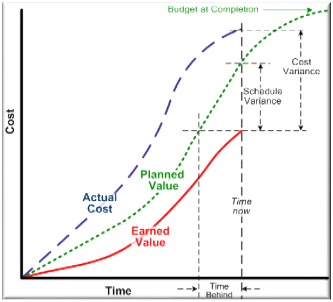
Simply stated, Earned Value Management (EVM) processes, systems and software enable the continuous assessment of project performance and status — helping management effectively measure how projects are aligned with resources and goals.
EVM helps project managers to measure project performance.
It is a systematic project management process.
Its main use is to find variances in projects based on the comparison of work performed and work planned.
EVM is used for cost and schedule control and can be very useful in project forecasting.
It is focused on cost and schedule efficiencies.
EVM is an excellent tool, but if it isn’t utilised, or is used irregularly, then it does not benefit the project. As the leader of the project, it is imperative that the Project Manager understands how the data is calculated, where the numbers come from, and what events lead to the current state of the project. That way, the information can be interpreted correctly, and actions can be taken to ensure project success.
Just using Earned Value to manage your project doesn’t automatically guarantee success. In fact, using it incorrectly can even be more harm than good if it is not fully understood well.
We are going to talk about the proper implementation of Earned value management as a tool for project success to ensure the project delivery on time, and on budget with simple ten steps as below.
Step 1 – The inputs:Definitions and details. The first, and perhaps most important, criterion for successful EVM practices is clearly defining the project scope, including objectives and deliverables. If managers do not clearly define what constitutes 100% of the project, how can they accurately represent status down the road?
Step 2– Resources:Who’s doing what next? The EVM policy team should define who will perform the work, and identify any necessary resources from internal and outside the team. Understanding and carefully selecting internal and external resources mix is an essential element of project planning. Remember it is not the number of people but the right people at right time.
Step 3 – Plan and schedule:Keys to execution. A project plan (what and how) backed up by a good schedule (who and when) system with integrated budgets and resources, EVM requires the creation of project schedules that describe the sequence of work and identify significant task interdependencies. A detailed project plan that accurately describes the project scope and planned value — then measures the resulting earned value — allows project managers to quickly identify project variances and take corrective action early on.
Step 4 – Budgeting:Use rates you know. After clearly defining the project scope and schedule, project team must estimate the budgets for all tasks and resources. Project managers need to keep track of the various resources and their respective rate structures, then map them to defined cost-accounting processes. Managers should apply rates discretely — especially over long programs — to project both current and future costs, that means rates for budget, actual and forecast.
Step 5 – The starting gate:Rely on a baseline project. Managers must define the time-phased budget baseline for total scope against which they will measure project progress, including both direct and indirect costs for each subproject. Stakeholders must agree on the starting point and midstream metrics, as well as ensure that outcomes and agreements are well-documented and communicated.
Step 6 – Evaluation:Your definition of progress. Typically, organisations specify what physical products, outputs, metrics, milestones, and technical performance indicators they will use to measure the actual work accomplished against the scheduled plan. Whatever the metric is, the key to project success is the communication of, and agreement on, these objectives across the project team. Agree and communicate Rule of Credit (RoC).
Step 7 – Cost control: Align actual costs to the project budget. Throughout a project, managers must remain informed about money spent to date and have a true understanding of remaining resources. The best way to keep costs in check is to establish a formal system that is controlled by a cost controller, where all direct costs are attributed to the specific project requiring the resource. All indirect costs are also captured accurately.
Step 8 – Monitor:Monitor, monitor, monitor. Once a program is underway and baselines have been established, it is imperative to continuously monitor performance to determine any cost and schedule departures from the baseline plan.
Step 9 – Forecast: Avoid surprises. EVM provides the ability to quickly and independently forecast the total funds required to complete a project. At several points along a project’s timeline, project managers should use the earned value data to forecast the final required costs and keep management apprised of the status.
Step 10 – Change: You can count on it. Change is the only constant in life — and in projects. By defining change management processes upfront in EVM policies, management and project teams alike are better prepared to deal with the inevitable. Additionally, it is imperative to adjust project baselines when changes occur.
Need help? Explore how zerofloat can help you control your project.
Here’s what a PMO model that really adds value looks like:
🧩 1. Strategic by Design Not just aligned with strategy – shaping it. – Supports portfolio prioritisation based on value, not politics – Provides the exec team with early warning signals before projects go off the rails
📊 2. Data-Driven, Not Document-Driven Forget death by dashboard. – Uses predictive analytics to spot schedule and cost risks – Powers real-time insights, not rear-view reporting
🤝 3. Embedded and Empowered Not a silo. Not the process police. – Co-located with delivery teams – Acts as an enabler, not a gatekeeper
🧠 4. Talent-Led, Not Template-Led Anyone can follow a checklist. – Your best PMO people are advisors, analysts, and change catalysts – They challenge assumptions and drive delivery with confidence
💡 PMO Value = What You Enable – What You Cost If your PMO is costing more than it’s creating — it’s time to rewire, not retire.
Are you leading a PMO that’s adding strategic firepower, or just more paperwork?
Let’s hear it: 📣 What’s ONE thing your PMO does that truly changes outcomes? 📣 Or… what needs to change to get there?
Feel free to share your thoughts below and repost 🔁
Need help? Explore how zerofloat can help you control your project.
Have you heard about The Influence Curve? The influence of stakeholders and the cost of change have a direct relationship and it all depends on time.
Projects are vehicles of change…The key is to identify change early.
Project research, as far back as Baker and Paulson in the 1970s, shows that definition and relationship management activities in the earliest stages of the project exert a significant influence over a project’s outcome. It is early in the project that the ability to influence the outcome is the greatest and costs are the lowest, as time passes the influence of stakeholders will be low and the cost of change can become very high when good things turn bad.
As a rough indicator, Paulson suggested a 25% remaining level of influence by the time construction commences on a grass-root petroleum refinery. As such, the initial designers and decision-makers have a tremendous impact on how the project will end up.
Allocating adequate time and resources early in the project to clarify the objectives, scope, and requirements, as well as to build stakeholder relationships is a prudent project practice.
I am a strong believer that the Cost Influence Curve can be stretched significantly for the full project lifecycle. By having expert personnel, one influential and powerful stakeholder at a critical time, following sound project management practices and using efficient tools you can significantly reduce your risk of ending up with a disaster project.
Share your project story.
Need help? Explore how zerofloat can help you control your project.