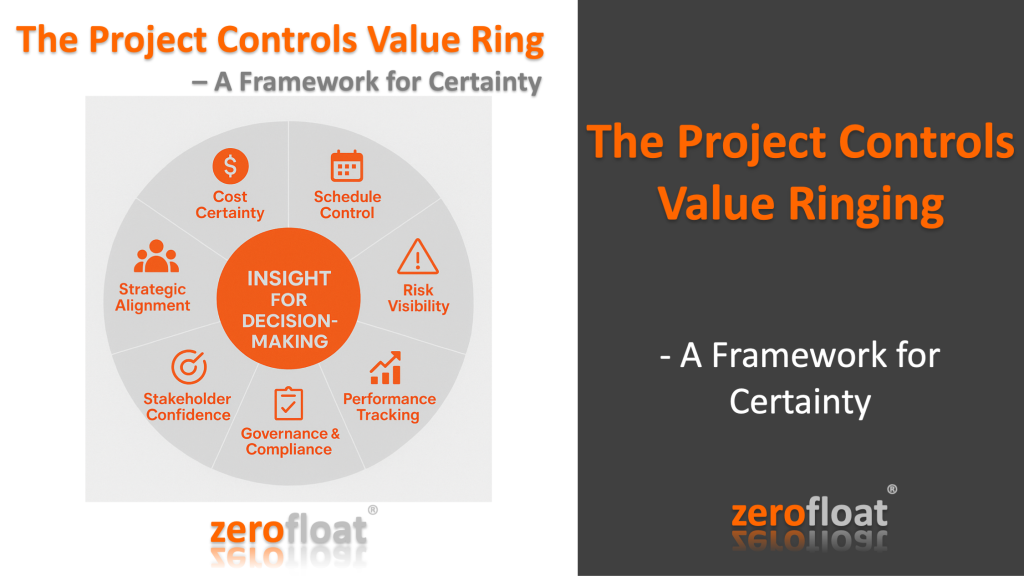
The Project Controls Value Ring

Project controls isn’t just a function—it’s a value engine.

This Value Ring shows how project controls delivers certainty across every layer of a project, from daily decisions to strategic delivery:

At the core is what matters most:
🎯 INSIGHT FOR DECISION-MAKING – where data turns into clarity, and clarity into confident action. The ability to make proactive, informed decisions is the ultimate value-add.

Surrounding Domains include:
💰 Cost Certainty – Clear forecasts, controlled budgets
🕒 Schedule Control – Realistic timelines, critical path visibility
⚠️ Risk Visibility – Early warnings, quantified impact
📊 Performance Tracking – Progress accuracy, data-driven reviews
📝 Governance & Compliance – Assurance, auditability, integrity
🤝 Stakeholder Confidence – Trust built through transparency
🎯 Strategic Alignment – Projects that serve the mission, not just the plan

This is the value ring that drives major projects forward, especially in complex environments like defence, infrastructure, mining and metals, oil and gas, power and coal, LNG, chemical and petrochemical, and capital-intensive delivery.

At zerofloat, we use this lens to strengthen project controls and PMOs, sharpen controls, and help leadership teams move with confidence.

Which part of the value ring does your organisation struggle with most, and how are you addressing it?

Need help? Explore how zerofloat can help you control your project.

Project Controls is a Waste of Money

“Project Controls is a Waste of Money – Unless You Actually Use It”

Companies spend millions on fancy project controls systems, detailed schedules, cost forecasts, and risk registers—only to ignore them when making decisions. What’s the point?

If your leadership treats Project Controls as a reporting function instead of a decision-making tool, you’re just burning cash.

Here’s how Project Controls is wasted every day:
❌ Schedules that are updated but not followed.
❌ Risk registers that exist for audits, not action.
❌ Cost forecasts that are ‘adjusted to fit’ instead of exposing the truth.
❌ Teams that deliver reports but don’t influence decisions.
Project Controls is not about producing reports. It’s about controlling projects.

👉 If your Project Controls team isn’t helping shape strategy, challenge unrealistic plans, and drive accountability, then yes—it is a waste of money.

But when used properly? It’s the difference between a successful project and a disaster.

Here’s how Project Controls is used wisely to add value every day:
✅ Decision-making tool
✅ Helping shape strategy and plans
✅ Challenge unrealistic plans
✅ Drive accountability
✅ Don’t overcomplicate things
✅ Don’t sit on the sidelines

So, be honest—is your organisation using Project Controls effectively, or just paying for expensive theatre?

Drop your thoughts below and feel free to repost.

Need help? Explore how zerofloat can help you control your project.


Mastering Project Slowdowns: 9 Strategies to Keep Your Project on Track

Project delays can be a daunting challenge for any team, but before accepting them as inevitable, it’s crucial to explore proactive approaches to control and mitigate slowdowns. In this blog post, we will delve into nine effective strategies that project managers can employ to navigate through setbacks and ensure successful project completion.

Try these approaches before accepting the inevitability of a delay in project completion.

1. Renegotiate with Stakeholders:

The first step when facing potential delays is to open up a transparent dialogue with stakeholders. Discuss the possibility of increasing the budget or extending the deadline. By renegotiating expectations, you can gain the necessary support to overcome unforeseen obstacles without compromising the project’s success.

2. Use Later Steps to Recover:

Reevaluate your project’s budgets and schedules to identify areas where time can be made up. Shifting resources or rearranging tasks might provide opportunities to regain lost ground. A strategic analysis of the project timeline can uncover hidden possibilities for recovery.

3. Narrow the Project’s Scope:

Consider whether nonessential elements of the project can be dropped to reduce costs and save time. Streamlining the project’s scope allows for a more focused approach, ensuring that essential tasks are completed efficiently without unnecessary complications.

4. Deploy More Resources:

Evaluate the possibility of putting more people or machines to work on critical tasks. While this might incur additional costs, weigh them against the importance of meeting the deadline. Sometimes, an infusion of resources can significantly expedite project timelines.

5. Accept Substitution:

In certain situations, opting for a less expensive or more readily available alternative can be a pragmatic solution. Assess the feasibility of substituting certain components without compromising the overall quality or success of the project.

6. Seek Alternative Sources:

If a specific item or resource is causing delays, explore alternative suppliers or sources. Diversifying your options can mitigate the impact of a single point of failure, ensuring that the project can progress smoothly even in the face of unforeseen challenges.

7. Accept Partial Delivery:

Consider accepting partial delivery of items that are ready now and postpone the remaining components. This allows work to continue on other aspects of the project while waiting for the outstanding elements. It’s a strategic compromise that can prevent a complete standstill.

8. Offer Incentives:

To motivate teams or suppliers to meet deadlines, consider providing bonuses or other incentives. Positive reinforcement can create a sense of urgency and commitment, fostering a collaborative atmosphere geared towards on-time delivery.

9. Demand Compliance:

In some cases, insisting that individuals adhere to their commitments can be a powerful strategy. However, exercise caution and use this tactic selectively, seeking support from upper management if necessary. Striking the right balance is crucial to avoid damaging important relationships while still driving toward project success.

Conclusion:

While project slowdowns may seem like insurmountable challenges, employing these proactive strategies can significantly improve your chances of staying on track. By fostering open communication, flexibility, and creativity, project managers can navigate through unexpected setbacks and lead their teams to successful project completion. Remember, with the right approach, even the most formidable obstacles can be transformed into opportunities for growth and success.

Need help? Explore how zerofloat can help you control your project.

Checklist for setting up project controls function

Setting up a project controls function is essential for effective project management. This checklist outlines the key steps and considerations for establishing a project controls function within your organisation. Customise it to suit your specific project and organisational needs:

01. Define Objectives and Goals:

02 Allocate Resources:

03 Develop a Project Controls Plan:

04 Select Project Controls Software:

05 Define Reporting Structures:

06 Set Up Data Collection and Management:

07 Risk Management:

08 Cost Control:

09 Schedule Management:

10 Quality Control:

11 Document Procedures:

12 Data Analysis and Reporting:

13 Continuous Improvement:

14 Integration with Project Management:

15 Compliance and Auditing:

16 Training and Development:

17 Stakeholder Engagement:

18 Performance Evaluation:

19 Emergency Response Plan:

20 Review and Adapt:

Setting up a robust project controls function is a crucial step toward successful project management.

This checklist can serve as a guide to ensure that you cover all necessary aspects during the setup process.

https://www.zerofloat.com.au/store/templates/checklist-for-setting-up-project-controls-function/

Need help? Explore how zerofloat can help you control your project.
Tips for setting up Project Controls Function

Are you in the process of setting up a project controls function for your project or organisation?

It is a challenging task.

Let’s talk about the tips for objectives, success factors, risks, and issues that can help you with the task.

Setting up a project controls function is a critical step in ensuring the successful execution of projects within an organization. Here are some tips for defining objectives, success factors, identifying risks, and addressing issues:

Objectives

  1. Project objective realised
  2. Projects delivered on time and budget
  3. All variances managed, explained, and approved
  4. Smooth predictable delivery throughout
  5. Final project outcomes predicted well in advance

Success factors

  1. Project Controls process implemented & adhered to
  2. Suitable project data structures implemented
  3. Process tailored to meet specific project requirements
  4. Staff adequately trained & supported
  5. Appropriate systems properly configured & supported
  6. Project mindset to control: Scope, Cost, Time
  7. Change management focus

Risk and issues

  1. Controls function inadequately resourced
  2. Lack of team buy-in to control the process
  3. Scope Creep/Change management ignored
  4. Warning and lead indicators ignored
  5. Overly optimistic/unrealistic schedule and progress measurement
  6. Discrepancies in data from various sources can lead to confusion and misinterpretation
  7. Delays in collecting, analysing, and reporting data can impact decision-making and responsiveness

Remember that successful implementation of a project controls function requires a combination of process design, technology, stakeholder engagement, and ongoing monitoring.

Regularly review your objectives, success factors, risks, and issues to ensure that your project controls function remains effective and aligned with your project or organisation’s goals.

What tips would you add to the list above?

Need help? Explore how zerofloat can help you control your project.

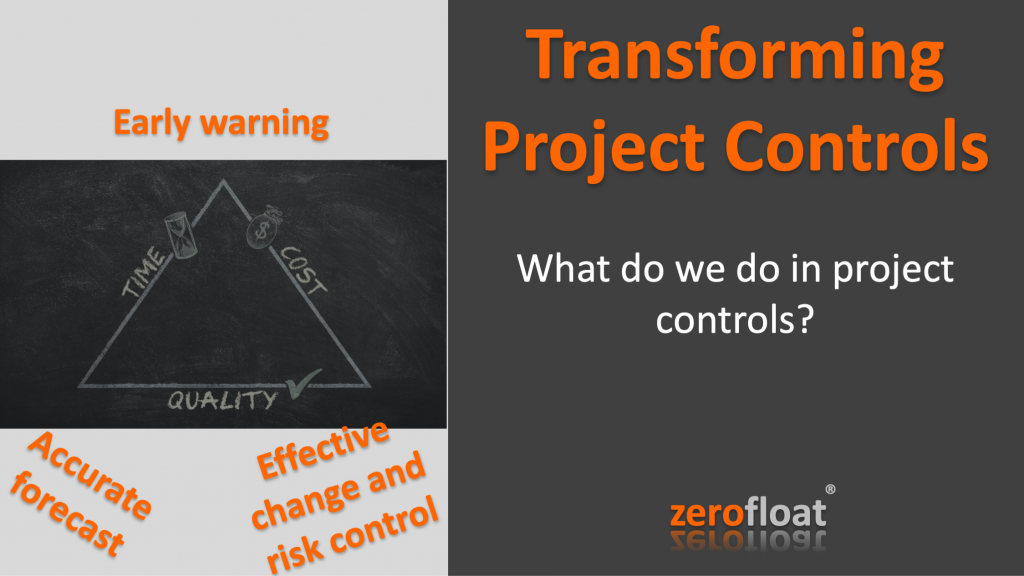
Transforming project controls

What do we do in project controls?

Many professionals still struggle to understand project controls real value add to project success.

It is simple,

Project controls provide 3 things:

1.      Early warning

2.      Accurate forecast and

3.      Effective change and risk control

Project controls, it is all about providing the right information, at the right level to assist project leaders to make the right decisions.

Project controllers may not have a crystal ball that can predict the project’s future but have tools and expertise that can help to make the right decision, at right time.

The world is changing fast.

4D,5D, AI, RPA, AR, VR, BigData, RFID, Drones …these are not just fancy hi-tech words anymore, but it is becoming a reality.

But remember decision-making is still done by humans in the project world.

Transforming project controls is all about professionalising this rapidly growing profession, bringing the community together, sharing lessons learnt and contributing towards its continuous improvement.

We know that billions of dollars are wasted every year due to poor project performance.

Let’s add value by effective use of Project Controls.

Let’s contribute to society by delivering projects successfully.

Need help? Explore how zerofloat can help you control your project.

Triple constraint

The Classical Triple Constraint model includes Cost, Time and Scope. The enhanced model includes an additional three constraints Quality, Benefits and Risk. Safety is a non-negotiable element.

Is that the Triple Constraint (six in the modern world) really useful for measuring project success or evaluating competing demands?

If you need to compromise on one, which one will be your pick? Not an easy answer.

That reality is also expressed as the pick two principle, which maintains that for any given set of three desired qualities or expectations — such as “good, fast and cheap” — it is likely that only two can coexist: A given product/project might be delivered quickly and inexpensively, for example, but the quality will suffer.

More often, a project manager needs to weigh one constraint against another to reach the best result and when the project is balanced well will lead to success.

What is your experience in managing a successful project?

Need help? Explore how zerofloat can help you control your project.